

 Contact us
 Visit CPRE.org
 Donate
Somerset Star Count – help us to map local light pollution this February

Between 14 – 21 February 2026, we are inviting you to take part in our Somerset Star Count, a cosmic census to map our view of the night sky.
A star-filled sky is one of the most magical sights you can see in our countryside and the stars have inspired art and culture for thousands of years. But too often, light pollution means that many of us can’t see the stars, especially if we live in or near a big town or city.
Just 3% of people in the UK experience ‘truly dark skies’.
But together we can work towards rewilding the night for the benefit of people and wildlife, which is why we’re organising our own Somerset Star Count. Join in by choosing a clear night between 14 – 21 February and counting the number of stars you can see within the constellation of Orion. It’s easy to do, and you don’t need a telescope or any equipment.
Your results will help us generate a map of Somerset’s view of the night sky, and where light pollution is at its worst, so we can try to make things better. It’s a family-friendly activity that’s quick, fun and easy to do.
How to do your Somerset Star Count
During the week of 14-21 February, choose a clear night and:
- Wrap up warm If you’re heading to your garden or further afield, wrap up before you head outside. You want to be able to comfortably stay still as you look up at the night sky and it can get chilly at this time of year! Take a thermos of something warm if you’re planning to make an evening of it.
- Turn off all the lights in your house. Light from your home can affect the number of stars you will be able to see. Turn off all the lights in your home and let your eyes adjust to the darkness. You could even get your neighbours to join in and do a count at the same time!
- Let your eyes adjust to the darkness. The longer you wait, the better you’ll be able to see the stars (we recommend at least 20 minutes to let your eyes adjust) While you’re waiting, why not listen out to see if you can hear any night-time wildlife?
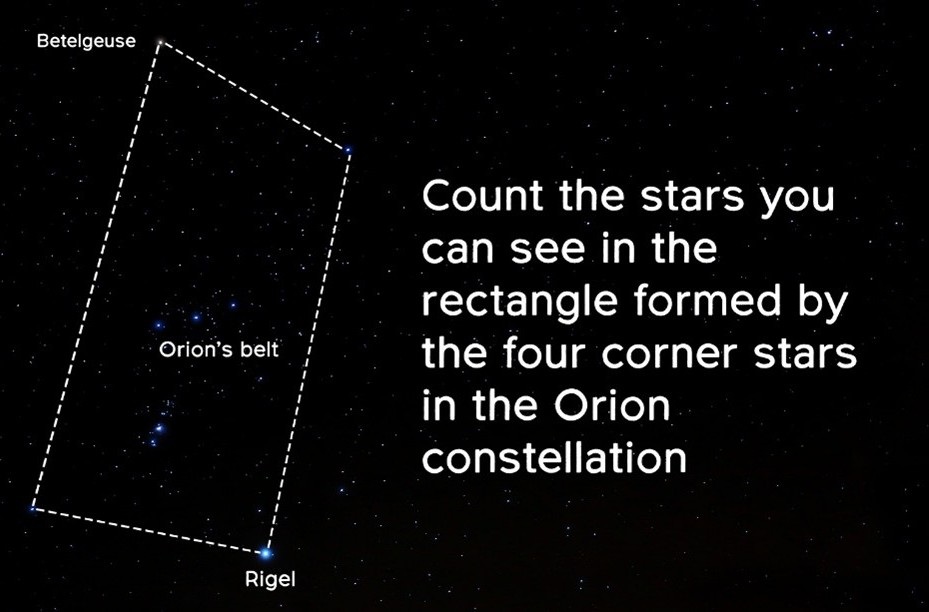
- Count the stars in Orion Look south (the way satellite dishes point) and find the Orion constellation. It’s best to look for the three bright stars in a row that form Orion’s belt. Now find the four stars that form a rectangle around the constellation. Then count all the stars you can see within that rectangle. Include Orion’s belt, but not the four corner stars. Here’s an image of Orion to help you.
- Send us your results Click the button below to open up a form that allows you to send us your results. This form will be available from 14th February onwards.